ActiveCitizenship
Knowing what's going on and having a say in it, not just on election day.
Continue to why it mattersWhydoesitmatter?
You see something wrong and think,
“someone should really do something about that?”
That's
awareness.
But awareness on its own never fixed a thing. It's a starting line.
The finish line is what you do next.
Activecitizenship!
Out of 100 Slovenians, only 41 voted in the last European election.
Apathy isn't the problem. The same people who skip elections run volunteer fire brigades and shovelled mud for strangers after the 2023 floods. That energy just never makes it into politics.
59 stayed home
So we went looking for what stands in the way. The same five problems kept coming up. Every one of them is fixable, and that's the rest of this page.
The work
Fiveproblems,fivesolutions
Every problem below comes with the fix we'd start on: how it gets built, what it costs, and who has to act. Cost notes are our own estimates, marked est., not sourced statistics.
Problem 01
Nobody taught us how power works
At eighteen the state hands you a ballot and wishes you luck. School got us through the periodic table but never mentioned who decides where the bus runs. Social media became the main place young people get political news, and 76% have already run into disinformation there. So first-time voters guess, or stay home.
76%met disinformation · only 18% sure they can spot it · 2024
Solution 01
Civics in every homeroom
One civics workshop a year, for every high-schooler, inside homeroom hours that already exist. Nobody has to fight for timetable space, and the material grows up with the students.
How it worksHalf the hour is a misinformation lab: students take apart a real article or TikTok by asking who made this, what do they want from me, and what feeling is it fishing for. The other half maps who decides what, from their municipality up to the EU, so that by graduation everyone knows which office to take a problem to. The Ministry of Education writes the frame, teachers and municipalities deliver it, and local organisations bring cases from their own town. School is the one place you reach everyone.
est.materials and teacher training; the hour itself is already in the school week, so delivery costs almost nothing.
Implemented by: Ministry of Education + municipalities, teachers and local organisations
If it worksA generation that checks a claim before sharing it, and knows who to write to when the bus line gets cut. Every other idea on this page assumes citizens like that exist. This one is where they come from.
Problem 02
People stopped trusting politics
“Why bother, nothing changes.” We hear that sentence more than any other. Some of it is fear, some is the reflex that politics must be dirty. Most of it, we think, is simpler: there is no way to check for yourself what the government does, because everything official comes out in legalese. And once somebody skips an election for that reason, the skipping tends to stick.
15%believe people like them have a say in what government does · OECD 2024
Solution 02
Policy for Dummies
Publish every euro of public money in a searchable register. Give every law one plain-language page answering “what changes for me?”. Then give people somewhere to practise: debates in homeroom, and a national forum anyone can write for.
How it worksTransparency goes first: public spending published in one searchable register, down to individual payments, because asking people to trust works better when they can check for themselves. Then every law and decision gets its Policy for Dummies page, plain words, one question: what changes for me? Practice comes last. Homerooms debate real topics, local and European, until disagreeing out loud feels normal, and the national forum lets anyone write and publish, with professional journalists editing drafts the way a newsroom edits its own writers. The national government sets the transparency rules and the plain-language pages; schools and civic organisations run the debates and the forum.
est.editorial work inside websites the state already runs; the forum itself is a few thousand euros a year plus the reviewing journalists' time.
Implemented by: national government + schools and youth organisations
If it worksYou open your phone and understand where your municipality's money went this month. Arguing about politics costs you an evening instead of a friendship. And politicians behave differently once they know every receipt is public.
Problem 03
Everything happens somewhere else
Youth events, workshops, hackathons: nearly all of it runs in Ljubljana or Maribor, whenever an organiser lands funding for it. If you live in a village, attending means finding a bus that runs after eight. If you use a wheelchair, the venue was chosen before anyone thought of you.
200/212Slovenian municipalities aren't cities · the events are in the other 12
Solution 03
Events that come to you
Pay organisers more when they run things outside the big cities, subsidise tickets down to free, stream every event, and make accessibility a condition of public funding.
How it worksThe change starts in the funding rules: programmes that run in rural or less-developed municipalities score higher and cost the organiser less, which makes going rural the profitable choice instead of the charitable one. Ticket prices scale with what a family can pay, down to zero. Every event gets a stream for whoever still can't come. Accessibility gets planned while it's cheap: venues picked for step-free access, and trained volunteers on the day helping participants with disabilities get in, around, and home. National funding programmes set the incentives; municipalities and organisers do the rest.
est.the incentives redirect money that already flows; a stream is nearly free, and access planned upfront costs a fraction of retrofitting it.
Implemented by: national funding programmes + municipalities and organisers
If it worksA seventeen-year-old in a village gets the same invitation as one in Ljubljana, and can accept it. So can her classmate in a wheelchair. Nobody has to move to the capital just to take part in things.
Problem 04
Politics is run by people twice our age
Education policy is written by people who last sat in a classroom forty years ago. Only 2.2% of Slovenia's MPs are young, and the average MEP is 50. When young people do speak up, we arrive as guests with opinions, and guests are easy to wave away.
2.2%young MPs in Slovenia 2020 · avg MEP: 50
Solution 04
Youth Mayors
Every municipality elects a youth mayor, with a youth assembly behind them. Together the youth mayors form a national Youth Council with a standing slot in parliament. Elected rather than appointed, they arrive with the one thing politicians take seriously: a mandate.
How it worksYoung people in each municipality elect one of their own for a one-year term with a seat in real municipal decisions. The assembly behind them gathers issues from schools and clubs, and gives the mayor someone to answer to. The national Youth Council carries those issues into parliament at fixed sessions. Start with a few municipalities that volunteer for the pilot; spread when it works. Terms are short on purpose, so hundreds of young people pass through the job and a new cohort learns it every year.
est.mostly administration; the elections run through schools and youth organisations, and the Youth Council needs little more than a room and travel money.
Implemented by: pilot municipalities + national parliament
If it worksEvery municipality hears from its young people through someone those young people chose. Parliament gets a counterpart it can't politely ignore. And ten years from now, some former youth mayors are running for the real thing with a decade of practice behind them.
Problem 05
Everyone builds alone
Two organisations in one town both run a media-literacy workshop on the same weekend; the next village over gets nothing. The grant system all but orders this: everyone competes for the same calls, so everyone plans alone, and nobody is in charge of the map as a whole.
1+1<2the same event twice · the next village empty
Solution 05
The Active Citizenship Network
One national network: a public calendar and map of youth activities, plus matchmaking between organisations working on the same thing. The teeth are in the grant rules, which score joint projects above solo ones.
How it worksThe calendar and map go up first, publicly, so overlaps and blank spots are visible to anyone who looks. When two organisations turn out to be planning the same thing, the network introduces them and points them at a joint grant track. The scoring rule does the persuading, because a joint application now beats a solo one. The assumption behind it is unsentimental: people cooperate when cooperating pays.
est.one national coordinator and a website; the grant money it steers already exists and simply gets awarded under different rules.
Implemented by: national youth office + local organisations
If it worksThe same budget covers twice the ground, and the blank spots on the map start to fill in. The other four ideas get easier too, since every workshop, debate and youth assembly now has one obvious place to organise through.
The payoff
What if all five came true?
These five ideas are our best guess at how taking part becomes normal. To see what they add up to, follow one person: a fifteen-year-old in a small town, a few years from now.
- 01
In Monday's homeroom she takes apart a viral post in about a minute, with the three questions she has asked a hundred times by now.
- 02
That afternoon she reads, in plain words, what her municipality decided yesterday and what it cost.
- 03
On Friday there's a workshop in her town for once, with a free ticket. Her friend comes too, wheelchair and all, because the venue was picked with her in mind. Kids from even smaller villages watch the stream.
- 04
At seventeen she runs for youth mayor and loses. The year after, she runs again and wins.
- 05
Behind her assembly's projects are three organisations that found each other on the network's shared calendar.
None of it is science fiction. It adds up to a school hour, some web pages, a bus, a ballot box and a shared calendar.
We'd rather not wait until we're fifty.
The answer
Allfive.Oneplace!
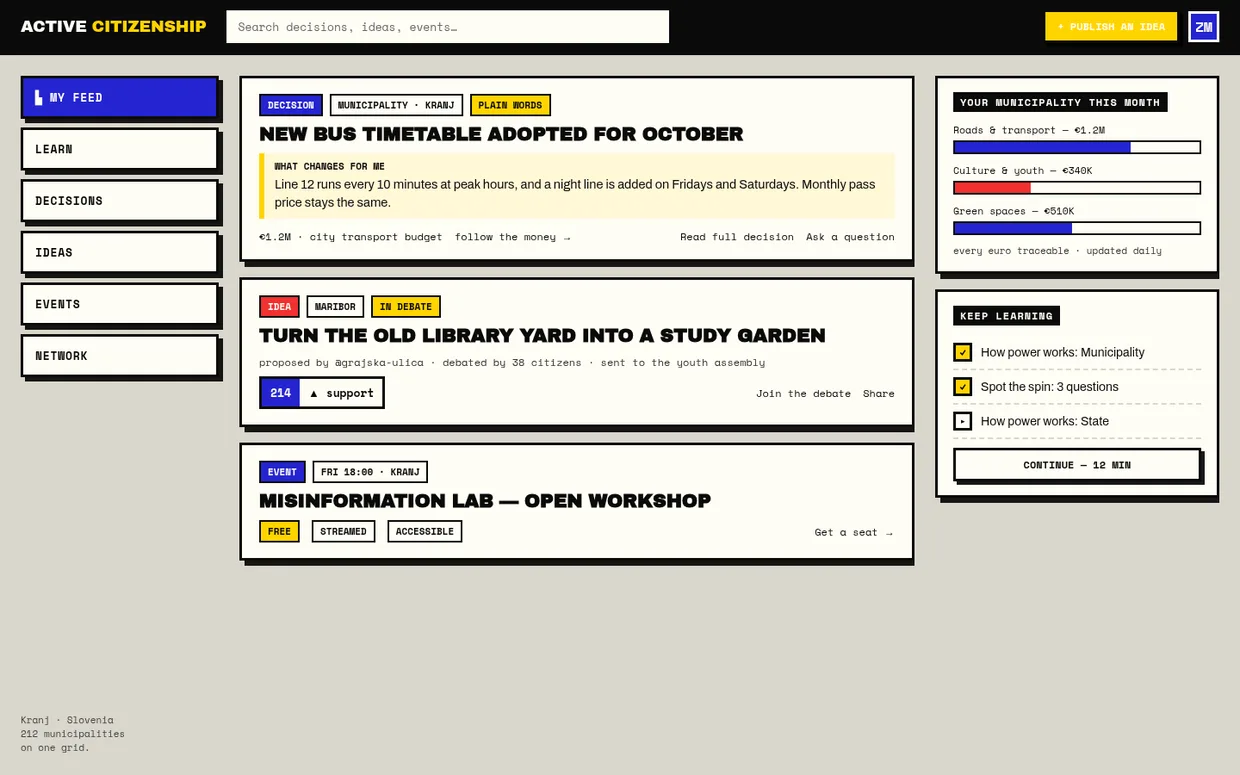
This is the platform that carries all five: the civics course, every decision in plain language, a place to publish what you think, and a map of what's happening near you. Built for schools and organisations, open to everyone.
41 in 100 is where we are today. Help us move the number.